For most of her life, Lina had a complicated relationship with her hair.
It wasn’t just curly. It wasn’t just thick. It was overwhelmingly frizzy, dry, and damaged beyond what most people could see at first glance. From a distance, it looked big and fluffy. Up close, it told a different story — split ends climbing halfway up the strands, uneven breakage from years of heat styling, faded color from old dye jobs, and a rough texture that felt more like straw than hair.

Humidity made it triple in size. Brushing it made it worse. Straightening it only gave her thirty minutes of smoothness before it puffed back up again.
She tried everything. Drugstore masks. Expensive serums. DIY oil treatments she found online at 2 a.m. Nothing worked. Eventually, she stopped trying to “fix” it and started hiding it — tight buns, claw clips, hoodies pulled up even when it wasn’t cold.
But inside, it bothered her more than she admitted.
When she finally booked an appointment with a corrective color and texture specialist, she told herself not to expect miracles.
The process took nearly five hours.
First, inches of damage were carefully cut away. Then came a bond-repair treatment to rebuild the internal structure of her hair. The stylist customized a smoothing and hydration ritual, layer by layer, restoring softness without sacrificing volume. Finally, a dimensional gloss brought richness and shine back to the dull, uneven color.
When the chair turned toward the mirror, Lina didn’t react at first.
She just stared.
The wild frizz was gone. In its place were sleek, healthy strands that reflected light. Her hair moved. It flowed. It framed her face instead of overwhelming it.
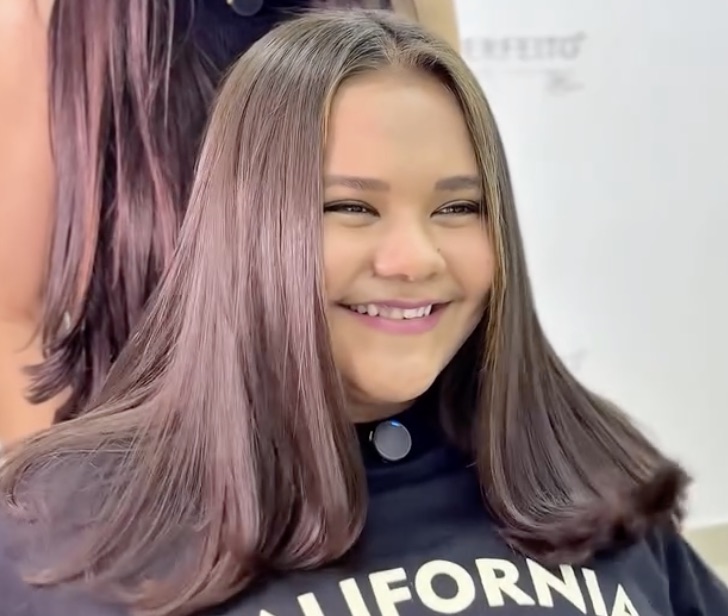
It looked like the kind of hair she used to screenshot on her phone and think, “That could never be me.”
But it was her.
And for the first time in years, she left a salon without tying it up.